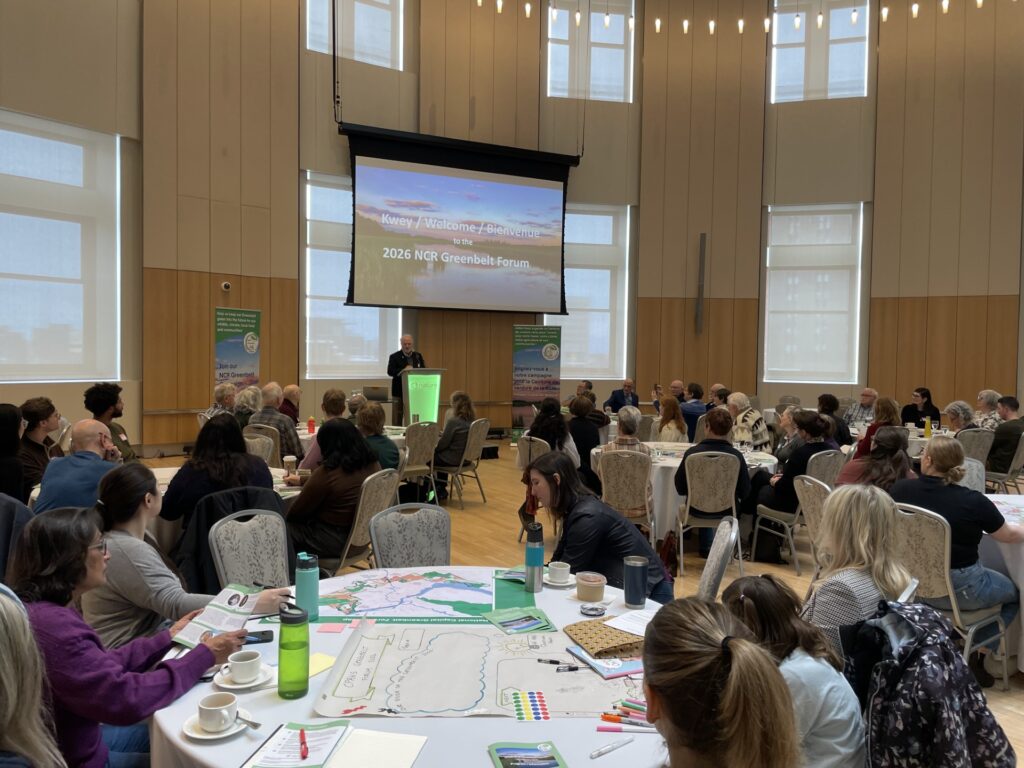
The Canadian Parks and Wilderness Society, Ottawa Valley Chapter (CPAWS-OV) brought a wide variety of stakeholders together at the Museum of Nature on Saturday the 21st of February to discuss the future of the NCR Greenbelt.
Including special talks from experts in conservation, restoration, sustainable farming and more, this event kicked off a campaign to protect, connect and restore the Greenbelt to ensure generations will continue to benefit from a greener Ottawa.
Consisting of 20,000 hectares of greenspace, including forests, rich agricultural land and internationally recognised wetlands, the NCR Greenbelt was created in the 1950s to safeguard the area against urban development. Today it is still enjoyed by many adjoining communities for its recreational opportunities while providing local produce thanks to the many farms within its boundaries. Unfortunately, the NCR Greenbelt has no real legislative protection, and so is at risk of being lost to new infrastructure projects, including the new ALTO high speed rail.
Keynote speaker Dr. David Gordon, Professor in the School of Urban and Regional Planning at Queen’s University, led the presentations with his talk entitled “Greenbelt to green heart”. Dr. Richard Pither, Research Scientist with Environment and Climate Change Canada also spoke as well as Jeremy Colbert, former Greenbelt resident farmer and co‑founder of BeetBox Co-operative Farm among others. The NCC presented on the history of the Greenbelt and how people can have their say in the new master plan.
Representatives from local community groups and organisations lent their voices to the conversation and took part in brainstorming activities. Filling the Salon at the museum, it was great to see so many show up for the love of the Greenbelt.
As the second largest greenbelt of any capital city worldwide, making it a protected urban park would send a message that Canada is serious about nature conservation while moving forward with our promise to protect 30% of our land and waters by 2030.
A recent report entitled: Widely Enjoyed but Inadequately Valued: Understanding the Economic, Environmental, and Health Benefits of Canada’s Protected and Conserved Areas by CPAWS national has found that Canada’s terrestrial and ocean protected and conserved areas provided $10.9 billion to Canada’s GDP (in the 2023-2024 fiscal year). This does not include the economic value of both their ecosystem services and their impact on our health and wellbeing. The value of an intact and flourishing greenbelt for the people of Ottawa should not then be dismissed in favour of the economic potential of infrastructure growth but should be measured for its very real benefits to our economy, our health and the certainty of our future when faced with climate change and biodiversity loss. In short, if the government wishes to “Protect Ontario”, we simply cannot afford to lose it.
Maggie Hanna, NCR Greenbelt Campaign Coordinator for CPAWS-OV says: “The Greenbelt has long been taken for granted and is now at risk of being lost due to urban growth and new infrastructure projects. Our vision is for a protected Greenbelt Canadians can be proud of where people can come together to celebrate the nature, community and history which makes Ottawa a great place to live.”
The Greenbelt Campaign, being led by CPAWS-OV, includes the creation of a coalition which will work together with the NCC to manage the Greenbelt for both nature and people. One of its goals will also be to increase awareness of and an appreciation for this historic green space through educational efforts: the creation of a website, organised community events and eventually, an education center.
Help protect the NCR Greenbelt! Sign up to our newsletter to find out how: CPAWS Ottawa-Valley Email Subscription | CPAWS – Ottawa Valley
For more information on the NCR Greenbelt campaign, follow this link: The National Capital Greenbelt – CPAWS-OV